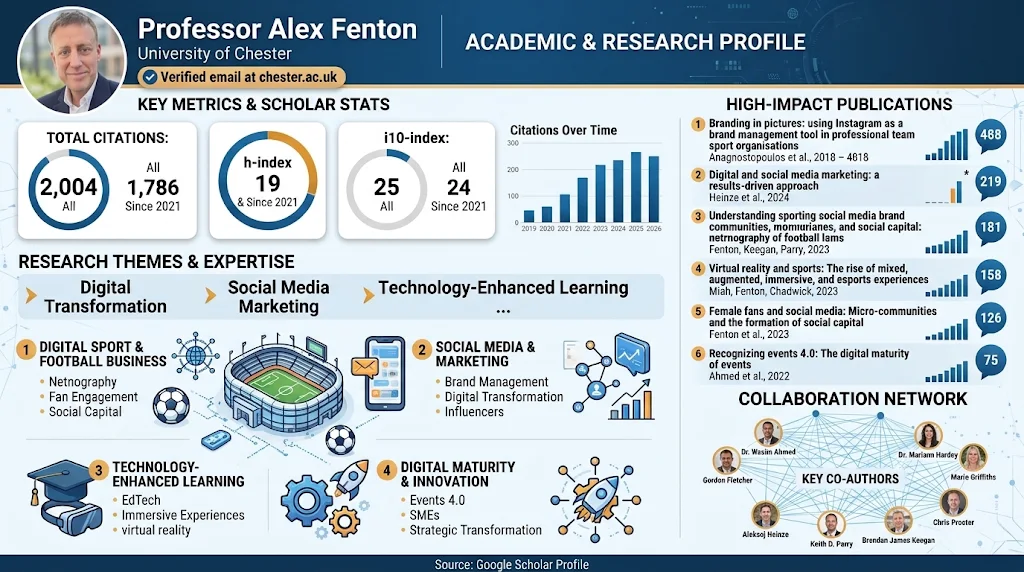
In November 2026, I passed 2,000 citations on Google Scholar with an h-index of 19. It made me pause and think about
And:
How many citations is considered good for an academic?
And perhaps most importantly:
How do you increase your citations and research impact?
This post unpacks those questions and gives a few thoughts purely from my perspective about how I arrived here. After completing my PhD in 2018, I have accumulated most of my citations in the last 5 years. Looking back at my publication record, there are some things I have learned about academic publishing that are potentially useful for doctoral students, early-career researchers and academics trying to build a research profile. There are also some important caveats. Citation counts and h-indexes are useful measures, but they are not measures of research quality in themselves. Citation behaviour varies enormously between disciplines, publication types and topics.The Declaration on Research Assessment (DORA) specifically recommends that quantitative indicators such as citation counts and the h-index should be used with context rather than as simple proxies for research quality.
What is a citation?
A citation is essentially a reference to your published research in somebody else’s academic work. If another researcher publishes a peer-reviewed paper and cites your article, your citation count increases. There are lots of reasons why researchers cite other work. They might be building on your findings, using your theory or methodology, discussing your argument, comparing their results with yours or disagreeing with you. So a citation does not necessarily mean that another researcher thinks your paper is brilliant. But it does mean that your research has become part of somebody else’s academic conversation. When I started my time at my current University, I remember asking some senior research colleagues a fairly basic question:
What does a good publication look like?
The answer surprised me.
At least 10 citations.
At the time, I was probably thinking more about getting published in good journals.
That answer made me think about what happens after publication.
A paper being published is not the end of the process. It is the point at which other researchers can start reading it, using it, challenging it and building on it.
What is a good citation rate?
This is where things become difficult.
There is no real universal answer to the question “How many citations is good?”
A paper with 10 citations could be highly cited in one discipline and relatively poorly cited in another.
Citation behaviour is very different across fields. The QS World University Rankings methodology, for example, explicitly recognises that citation rates vary substantially between disciplines. QS ranking is important, not just as a vanity metric for Universities, but to allow them to be able to enhance their recruitment and partnerships globally. Some governments stipulate that only Universities with a QS top 1000 ranking can partner with instititions in their country.
The age of the paper matters too.
A paper published in 2026 has had very little opportunity to accumulate citations compared with a paper published in 2016.
The number of authors matters. The size of the research community matters. The topic matters. The journal matters.
And sometimes, frankly, timing matters.
So I would be very cautious about telling an early-career researcher that 10, 20 or 100 citations automatically means that their research is “good”.
It depends.
What is an h-index?
The h-index is an attempt to combine the volume of research an academic has published with the number of citations that research has received.
An h-index of 20 means that you have at least 20 publications that have each received at least 20 citations.
It does not mean you have published exactly 20 papers.
It also does not mean your papers have an average of 20 citations.
It means that the 20th most cited paper in your publication record has received at least 20 citations.
Google Scholar’s documentation provides the formal definition of the h-index. It should be noted that Google Scholar is only one measure for these things, there are other’s and some are less generous in the way they rank and rate publications, but Google Scholar is considered to be a reputable source.
What makes h-index quite interesting.
Imagine two researchers.
- Researcher A has published one paper that has been cited 1,000 times and another 30 papers that have barely been cited.
- Researcher B has 25 papers, each cited at least 25 times.
- Researcher A has the larger total citation count.
- Researcher B has the higher h-index.
The h-index is therefore trying to capture something about consistent citation impact across a body of work, rather than rewarding one exceptionally successful publication.
So, what is a good h-index?
This is probably the question I get asked most often by researchers trying to understand academic metrics.
The honest answer is:
There is no single h-index that counts as “good”.
An h-index of 20 can be impressive for one researcher and relatively modest for another, depending on their discipline, career stage and publication history.
The h-index also has an obvious career advantage built into it.
Someone who has been publishing for 30 years has had much more opportunity to accumulate citations than somebody who completed their PhD three years ago.
This is one of the reasons DORA recommends that indicators such as the h
Imagine two researchers.
Researcher A has published one paper that has been cited 1,000 times and another 30 papers that have barely been cited.
Researcher B has 25 papers, each cited at least 25 times.
Researcher A has the larger total citation count.
Researcher B has the higher h-index.
The h-index is therefore trying to capture something about consistent citation impact across a body of work, rather than rewarding one exceptionally successful publication.
So, what is a good h-index?
This is probably the question I get asked most often by researchers trying to understand academic metrics.
The honest answer is:
There is no single h-index that counts as “good”.
An h-index of 20 can be impressive for one researcher and relatively modest for another, depending on their discipline, career stage and publication history.
The h-index also has an obvious career advantage built into it.
Someone who has been publishing for 30 years has had much more opportunity to accumulate citations than somebody who completed their PhD three years ago.
This is one of the reasons DORA recommends that indicators such as the h-index are interpreted in context.
So if you are a PhD student or early-career researcher looking at somebody else’s h-index and wondering whether yours is “good enough”, be careful about making direct comparisons.
A better question is:
Is my research gaining traction within my field and career stage?
Why do citations matter to universities?
This is not simply an individual vanity metric.
Universities themselves are increasingly assessed partly through research metrics.
One important example is the QS World University Rankings.
In the current QS methodology, Citations per Faculty accounts for 20% of the overall QS World University Rankings score. It sits within the Research and Discovery component, which accounts for 50% of the overall ranking.
Importantly, QS does not use Google Scholar for this measure. It uses data from Elsevier’s Scopus database and calculates citations per faculty member, with adjustments for factors including discipline and self-citations.
QS explains its Citations per Faculty indicator here.
So citations have consequences beyond an individual researcher’s CV.
They can contribute to how universities are compared internationally.
That helps explain why universities pay attention to citation performance.
How can you increase your academic citations?
This is where my own experience becomes useful.
I have now passed 2,000 Google Scholar citations, but I certainly did not have a masterplan at the beginning of my career that said:
“By 2026, I will have 2,000 citations.”
Most of the growth came from gradually learning what makes research more likely to be read, discussed and cited.
Looking back, I think there are several things that matter.
1. Publish good research in good journals
This sounds obvious.
It is also true.
My experience is that better-quality journals, including Association of Business Schools 3* and above outlets, can provide stronger opportunities for citation impact.
But this does not mean that publishing in the highest-ranked journal automatically produces the most citations.
It doesn’t.
A paper in a top journal can receive relatively few citations.
A paper in a less prestigious journal can become highly cited.
Journal quality is one factor.
It is not the whole equation.
2. Choose topics that people actually want to research
This might be one of the most important lessons I have learned.
My most cited paper is about Instagram, Manchester United and Liverpool.
When we wrote the paper, Instagram was still a relatively new platform and football clubs were beginning to use it in interesting ways.
We were examining something that was happening in the real world at precisely the point when researchers were starting to become interested in it.
The study combined social media content analysis with other methods and was published in an appropriate journal.
Looking back, we got a combination of things right:
- The right topic.
- The right time.
- The right journal.
- The right method.
And, if I am being completely honest, a bit of luck.
If we had written the same paper five years earlier, Instagram would not have been nearly as relevant.
If we had written it five years later, somebody else might already have done it.
Academic impact sometimes involves being in the right place at the right time.
3. Look for emerging topics
There is a temptation to research what everybody else is researching.
Sometimes that makes sense.
There is already an established academic conversation and therefore an obvious audience.
But there can also be opportunities in emerging areas.
Digital marketing is an obvious example from my own career.
Social media, influencers, digital transformation and, more recently, artificial intelligence have all generated substantial research interest.
The challenge is to get into the conversation before it becomes completely crowded.
That requires paying attention to what is happening outside academia as well as inside it.
What are organisations doing?
What technologies are emerging?
What are people actually using?
What problems are practitioners facing?
Those questions can sometimes produce more interesting research opportunities than simply looking at the topics that are already fashionable in academic journals.
4. Read the journals you want to publish in
One of the things I increasingly encourage doctoral students and early-career researchers to do is to really understand the journals they are targeting.
Don’t just look at the journal ranking.
Read the papers.
What kinds of questions are they asking?
What theories are being used?
What methodologies are being accepted?
What debates are taking place?
What do authors identify as future research?
That last point can be particularly useful.
If several papers in a target journal are saying that a particular area needs further research, that gives you a clue about where the academic conversation may be heading.
You are no longer simply trying to persuade a journal that your topic is interesting.
You are contributing to a conversation that is already taking place there.
5. Have a plan B and plan C
I encourage doctoral students and early-career researchers to have a go at the better journals.
Why wouldn’t you?
If you have good data, a strong research question and a potentially interesting contribution, aim high.
But have a plan B.
And a plan C.
Top journals have high rejection rates.
That is part of the point.
They have to reject good papers because they can only publish a limited number of them.
So when a paper is rejected, I try not to interpret it as:
“My research is rubbish.”
It might mean:
- The contribution isn’t sufficiently strong.
- The paper isn’t quite right for that journal.
- The theory needs developing.
- The methodology needs strengthening.
- The reviewers disagree.
- Somebody else has already published something similar.
Read the reviews.
Take what is useful.
Revise if necessary.
Then move on.
Sometimes you just have to shrug your shoulders and go to plan B.
What about books and book chapters?
My own citation record has also taught me something interesting about different types of publication.
One of our most highly cited pieces of work is our book on Digital and Social Media Marketing.
The third edition was published by Routledge and edited by Aleksej Heinze, Gordon Fletcher, Ana Cruz and me.
You can find the book on the Routledge website here.
From a traditional research assessment perspective, a book is not necessarily treated in the same way as a highly ranked journal article.
But the book has sold many copies and has subsequently been cited by other researchers.
That raises an interesting question.
What does research impact actually mean?
If we only count citations, we capture one part of the story.
If thousands of students read a book, that is potentially meaningful educational impact.
If a business uses an academic model to change what it does, that may be meaningful organisational impact.
If research influences policy, that could be significant societal impact.
None of these things necessarily produces a high h-index.
I have also written many book chapters.
Some have been cited.
Some have received virtually no citations.
It is difficult to know how many people actually read them.
That reminds me of something our former Head of Research used to say:
“Don’t waste good data on a book chapter.”
It was deliberately provocative.
But there was a serious point behind it.
If you have an excellent dataset and a genuinely interesting research question, think carefully about whether the work could become a strong journal article.
Book chapters can still be useful, particularly for developing your academic writing, building collaborations and getting started.
Just don’t automatically put your strongest research into the easiest publication outlet.
Should I try to publish in the FT50?
This is another question that increasingly comes up in business and management research.
The answer depends on your career strategy.
Some institutions place substantial emphasis on a small group of elite journals, including the Financial Times 50.
There is a logic to this.
Publishing in these journals is difficult and signals that research has passed an exceptionally competitive editorial and peer-review process.
But I would be wary of assuming that FT50 = impact and everything else = failure.
Citation impact does not work that neatly.
Nor does research impact.
A highly cited paper is not automatically a better piece of research than a less cited paper.
And a paper that has significant influence outside academia may not accumulate citations at all.
This is one reason DORA’s guidance on the responsible use of quantitative indicators recommends that indicators should be clear, transparent, specific, contextual and fair.
The problem with chasing citations
There is an obvious danger here.
If universities tell academics that citations matter, academics will naturally try to increase their citations.
But once a metric becomes a target, it can distort behaviour.
You might start choosing topics because they are likely to generate citations rather than because they are important.
You might focus excessively on journal rankings.
You might avoid interesting interdisciplinary research because it doesn’t fit neatly into a particular journal.
You might become obsessed with your Google Scholar profile.
I have seen enough of academic life to think that this is a genuine risk.
Metrics should help us understand research.
They shouldn’t become the reason we do research.
Do you need to be the only author?
Not necessarily.
There is sometimes an assumption that a strong academic needs to demonstrate that they can publish independently.
There is value in doing that.
But personally, some of my strongest research has been more collaborative.
Good co-authors bring different skills, theoretical perspectives, methodological expertise and networks.
They can also make the research process considerably more enjoyable.
I would much rather work with three excellent, reliable researchers on a genuinely interesting project than produce a mediocre paper simply because I felt I needed another single-authored publication on my CV.
There is no single formula for building a research profile.
So, what have I actually learned?
Passing 2,000 citations and reaching an h-index of 20 has made me think less about how to get published and more about what happens after publication.
If I had to reduce what I have learned to a few principles, they would be these:
- Publish good research.
- Aim for good journals, but don’t become obsessed with rankings.
- Choose research questions that matter and that people are likely to be interested in.
- Pay attention to emerging topics.
- Understand the academic conversation taking place in your target journals.
- Work with good and reliable co-authors.
- Have a plan B and C when a paper is rejected.
- Give your research time to accumulate an audience.
And perhaps most importantly:
Don’t confuse citation impact with research quality.
So, is an h-index of 20 good?
Well, I think it is worth being pleased about.
But I wouldn’t claim that it makes me a better researcher than somebody with an h-index of 10.
Nor would I assume that somebody with an h-index of 40 has produced research that is twice as good.
The number tells part of the story.
For me, an h-index of 20 and more than 2,000 citations mean that a reasonably substantial body of my research has been picked up and used by other researchers.
That is satisfying.
But the number I am most interested in is perhaps the one that cannot easily be measured:
Did the research actually make a difference?
Did it help another researcher?
Did it give a doctoral student an idea?
Did it influence a debate?
Did somebody use it in practice?
Did it help an organisation understand something differently?
Did it lead to another research project?
Those things are much harder to put into Google Scholar.
And perhaps that is the biggest lesson I have learned.
Don’t just aim to publish.
Aim to contribute to the conversation.
Frequently asked questions about h-index and citations
What is a good h-index for an academic?
There is no universal h-index that counts as “good”. Citation patterns vary by discipline, career stage, publication age and research area. An h-index of 20 can represent a substantial citation record for one researcher while being relatively modest for another.
The best comparison is usually with researchers at a similar career stage and within the same broad discipline.
What is a good number of citations for a research paper?
There is no universal benchmark. Ten citations might be a strong result for a paper in one field but relatively modest in another.
You should consider the age of the paper, discipline, topic, journal, publication type and citation practices within the field before deciding whether a paper is highly cited.
Is an h-index of 20 good?
An h-index of 20 means that at least 20 publications have received at least 20 citations each. Whether that is “good” depends on career stage and discipline.
It is therefore more useful to treat an h-index as an indicator of accumulated research impact rather than a universal scorecard for academic quality.
How can I increase my academic citations?
There is no guaranteed formula, but several approaches can help:
- Publish rigorous research in reputable journals.
- Choose research questions that have a genuine academic audience.
- Identify emerging research areas.
- Understand the conversations taking place in your target journals.
- Build strong collaborations.
- Connect new research to established literature.
- Make your research visible through appropriate academic and professional networks.
- Give your publications time to accumulate citations.
The objective should be to produce research that other people find useful rather than simply trying to generate citations.
Does publishing in a top journal increase citations?
It can, but it does not guarantee them.
Top journals generally provide strong visibility and publish research that has passed a highly competitive editorial and peer-review process. However, citation impact depends on many other factors, including topic, timing, research quality, audience and the size of the research community.
A highly ranked journal does not automatically produce a highly cited paper.
Is the h-index a measure of research quality?
No. It is a measure of citation-based research impact.
The h-index can provide useful information about a researcher’s publication and citation record, but it cannot capture every aspect of research quality, originality, significance or societal impact.
DORA’s guidance specifically cautions against treating quantitative indicators such as the h-index and citation counts as single-number measures of research quality.
What is the difference between Google Scholar, Scopus and Web of Science citations?
They are different databases with different coverage.
Google Scholar generally has broad coverage and can include a wider range of academic material.
Scopus and Web of Science use more curated databases and can therefore produce different citation counts and h-indexes.
This means you should always state which database you are using when reporting your citation count or h-index.
For example, my milestone in this article is specifically 2,000+ citations and an h-index of 20 on Google Scholar.
Why do university rankings care about citations?
Research citations are used as one indicator of research influence.
For the current QS World University Rankings, Citations per Faculty represents 20% of the overall ranking score. QS calculates this using Scopus data rather than Google Scholar.
See the QS World University Rankings methodology.
Should early-career researchers focus on their h-index?
I would keep an eye on it, but I wouldn’t make it the primary objective.
Early-career researchers have not had the same amount of time to accumulate citations as established academics. A new researcher is generally better served by developing strong research questions, publishing good work, building collaborations and establishing a coherent research profile.
The citations should follow the research.
Should I aim for an FT50 journal?
If an FT50 journal is relevant to your research and career strategy, absolutely consider it.
But have a realistic publication strategy.
Aim high, understand the journal, learn from rejection and have alternative journals identified.
A rejected paper is not necessarily a failed piece of research.
Sometimes it is simply a paper looking for the right home.
Do book chapters count towards citations?
Yes. If a book chapter is indexed and another publication cites it, that citation can contribute to your citation count.
However, coverage varies between databases.
Book chapters can also have value beyond citations, including knowledge exchange, teaching, practitioner engagement and developing academic networks.
What is the most important thing to remember about citations?
Probably this:
Citations are evidence that somebody has used your research. They are not evidence that your research is good in every possible sense.
A useful research strategy therefore aims for more than numbers.
It aims to produce research that other people want to read, discuss, use and build upon.

0 Comments